|
Introduction
The
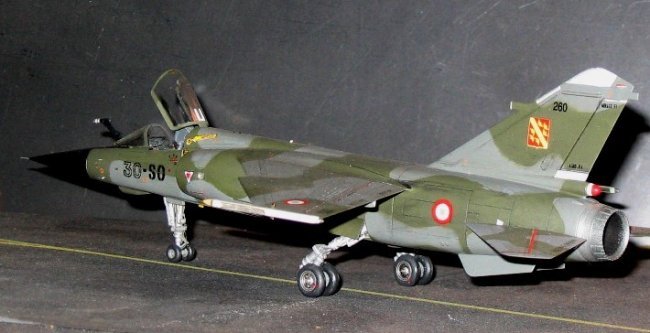
Mirage F1 CT is the ultimate development of the Mirage F1 series for the Armée
de l’Air (AdlA – French Air Force). The T stands for Tactique (Tactical)
meaning the aircraft no longer is restrained to its original air-to-air mission.
My
particular interest in the “CT” in the Mirage F1 family has two reasons : as
said above it might be the last development of the aircraft for the AdlA and
along with the Mirage 2000D, it is the only aircraft type in the French
inventory with the grey-green wraparound camouflage scheme.
Model
wise the Mirage F1 has been reproduced by several major brands. I believe the
Hasegawa is the neatest offer, albeit with raised panel lines. Some details
(parts and decals) of the Heller F1CT boxing were used to build this model.
|
Click on
images below to see larger images
|
|

|

|
Building
The
Hasegawa Mirage F1 model has been around for some years now and it shows. It is
a simple kit that actually depicts an F1C (Chasse = Fighter) version with or
without the fixed IFR probe.
Construction
started with the cockpit that was improved with a photo-etched flight deck and
consoles and an aftermarket MB Mk10 ejection seats. The Mirage F1 type
originally was equipped with the MB Mk4b in the AdlA but aircraft were later
retrofitted with the newer Mk10 bang seats. To my knowledge no Mirage F1CR (Reco
version) or CT ever flew with the Mk4 ejection seat.
Main
fuselage was quickly built. Sanding was performed all over to erase the raised
panel lines. Major structural lines were re-scribed for a more modern engraved
panel lines appearance.
Landing
gear was detailed with stretched sprue and plastic card. The Mirage F1 main gear
is attached to the main fuselage as they are on Mig 23s or Sepecat Jaguars and
this configuration generally generates quite complicated and visible gear
struts. Gear is painted dark silver and details are enhanced with a wash of
translucent “smoke” paint.
I
had planned to use the Heller fin as it incorporates all the add-ons of the CT
version. I later found this solution was impractical. I therefore decided to use
the Heller part as a guide to build up my Hasegawa fin with plastic card to
replicate the antennas and additional fairings. I also used my documentation to
add antennas and probes all around the airframe. The Heller nose designator was
cemented under front fuselage. Two light recesses are drilled on the side of the
jet intakes. They later will receive silver paint that will be covered with a
drop of white glue.
Painting
French
aircraft normally receive a standardized camouflage scheme. Mirage F1CTs receive
a wrap around camouflage scheme and belly surfaces are poorly documented. I
therefore was lucky to find a photograph of a banking aircraft in an old issue
of the French Air Fan Magazine (issue 175 if memory serves). This gave me a 90%
view of the under surfaces demarcation lines, enough to determine the rest.
I
used Gunze RAF green and grey colours on my model. Maybe a matter of colour
perception or print process but I have a feeling that grey-green camo colours of
French aircraft vary according to the type of aircraft (maybe depending on
workshop or maintenance depot). I feel the green of Mirage F1CTs has a brown
(olive) hue while the grey is bluer than on other aircraft.
I
then added light grey panels and black of course on nose cone and anti dazzle
panel. (later aircraft received a dark green nose cone – generally a slightly
lighter and greyer hue than the camo green.)
The
Heller decal sheet was used fully to provide all markings of this model. Another
nice addition of the Heller boxing is the huge “Iraqi fuel tank”. This tank
is the biggest that can be flown under the Mirage F1s fuselage and seems to drag
on the apron. These tanks are associated with the Mirage F1CT in the French Air
Force : it is thought their nickname stem from the fact they were originally
developed for the Iraqi Air Force. I finally decided not to use it on this model
: it will be used on another project.
The
Hasegawa Mirage F1 kit clearly no longer is up to the current standard of the
company. Still it might be the best basis to build a Mirage F1 in 1/72nd
scale, and with help from other brands, virtually any mark of the venerable F1
can be built. The Hasegawa moulding will be used again on future projects.
Eric
|
Click on
images below to see larger images
|
|

|

|
|