|
The
IAF has had several aerobatic teams over its 72 years of existence. From
Hurricanes in 1943 to a four ac vampire team in 1949 to several squadron teams
that fielded up to nine ac Hunter teams in the 50s and 60s including a 22 ac
Hunter loop using 7 and 27 sqn ac in 1959.
This was followed by the 4 ac MiG 21 FL team called the “Scorchers”
primarily because they formed by using ac from 29 (Scorpions) and 47 sqns (Black
Archers) in 1969. For a short while in the 1970s the Flying Instructors School
formed a four ac Kiran team called the ‘Silver Streaks’ (because they used
their bare metal ac). In 1981 it
was decided that for the celebration of the IAF’s golden jubilee, a nine ac
team would go round the country demonstrating throughout the year.
Within a year a nine ac team was worked up using 20 sqn (Lightnings) as a
platform, it being the last operational sqn on the Hunter 56. In keeping with
the sqn name the team was named the Thunderbolts and a suitable scheme of white
lightning bolts over an oxford blue was devised.
Commanded by Wg Cdr ‘Ben’ Brar the team came to the public eye for
the first time on Air force day, 08 Oct 82.
|
Click on
images below to see larger images
|
|

|
 |

|
|
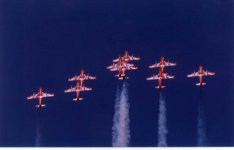
The Thunderbolts perform
over Hasimara in 1989 |
Surya
Kirans go over the top |
|
Since then the team
has displayed at almost every Indian airfield and at Colombo as well. Although
the team only displayed for nine seasons, it never lost a single ac in display
flying. The team was finally replaced (as the Hunter was simply
becoming too old for public formation displays) by a nine ac Kiran team called
the “Surya Kirans” (Sun’s rays).
The elegant barrels,
the thunder of nine Avons at nearly full power as they ran in at 300 ft from
behind the public, the immaculate formation changes in a 5g turn were the stuff
that kept little boys like me staring at the smoke trails in the sky long after
the crowd had left. Ultimately I
never got to fly the Hunter except for a few trips in the trainer; I was chosen
to fly the less elegant MiG 21. Since
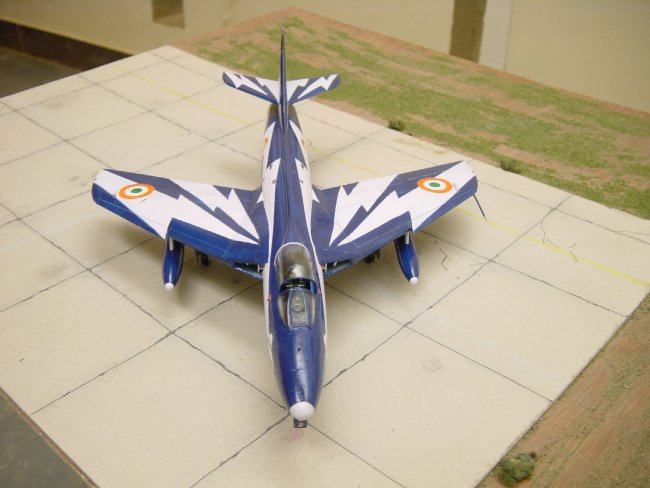
then I have always wanted to build the Thunderbolt Hunter, and this is it.
I had the bought the Academy FGA 6 before FGA 9 came to the market and
had to modify it to the Mk 56 with the addition of the tail chute container and
the removal of a few antennae. The
kit itself is renowned for its quality except for the complex, intake
trunk-to-wing root-to- fuselage assembly. I
decided to keep the rather under scale Mk 9 seat and left the canopy in the
semi-open position. Build was simple with few parts and good fit.
I sanded all the wheels down to give the weight effect also. For the
painting I decided to paint it overall blue and then mask each thunderbolt
individually. This took some time
and a lot of touch up later on. I
decided to keep the latter year’s scheme with the air force crest on the nose
replaced by the simple white disc and the numerals-20 in it
(probably as the ac was serviced and repainted it was simply to laborious
to do the crest again). This latter
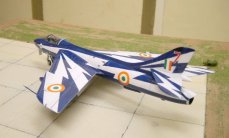
scheme also had a red and white numeral on the fin identifying the call sign, in
this case ‘Thunderbolt seven’ decided to use an RAF roundel without the red
inner. The blue matched perfectly and I inserted the 20 from the TallyHo RAF
serials. The white points on the tips of the nose, drop tanks and link collector
were formation keeping aids used in conjunction with the white bands on the
forward fuselage drop tank pylons and the black segment marks on the wing tips.
After the team disbanded and the ac went back to servicing they emerged
with many markings overlooked like the white bands on the link collectors and
the fuselage roundel moving forward or aft from its original location.
|
Click on
images below to see larger images
|
|

|

|
|
As an aside this was probably the
only ac in the world whose fuselage national markings (roundels) were bigger
than the wing markings. A coat of
Testor’s Gloss and then the Bright Spark IAF decals and kit decals for the
stenciling. White numerals from the
spares box were used for the serial on the nose (A 452), as no numerals existed
on the original tail position on most ac and the numeral seven on the fin.
At the end of it all I am quite satisfied with the finished product, it
does look something like the real thing!!
Polly
|
Click on
images below to see larger images
|
|

|

|
| A
thunderbolt pilot changes out of his sweaty overalls into his
ceremonials at Colombo. Note
the lack of an alphabet in the serial
|
Four
Hunters from 20 Sqn and OCU (the closest ac) with the OCU crest (much
misunderstood to be the 20 sqn crest) formate over the east coast long
after the disbandment.
|
|