|
This is my latest
effort, the Revell-Monogram 1/32 Mig Killer kit. This kit has been on the market
for several years now. This it the third one I've built, and I've enjoyed them
all! As I've built each one, I've noticed the age that the molds are seeing, but
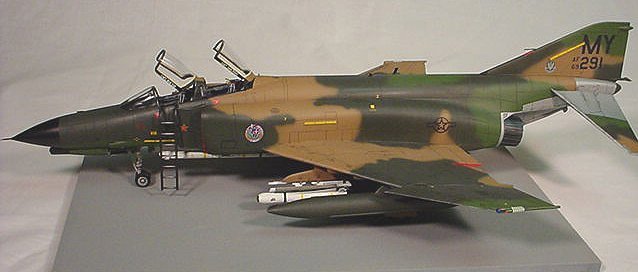
it's still a great kit. My model is finished as F-4E serial number 69-0291 of
the 68th TFS/347th TFW from Moody AFB in 1985. A good friend of mine was the
assistant Crew Chief on this plane. As for a little history for this jet, on
August 19th, 1972, Capts. Sam White and Frank Bettine shot down a Mig-21 while
flying MigCAP with the 4th TFS/366th TFW. Later in it's career, it was converted
to an F-4G Wild Weasel, and the last place I could trace it, it was assigned to
the 90th TFS/3rd TFW at Clark AFB until 1991. When that base closed, 291
was sent to Osan A.B. Korea. It was externally converted back to an E
model and became a static display jet outside the 36th Fighter Squadron.
It was repainted to Vietnam era camo and tail coded OS. Aeromaster did a sheet of
this jet as a G in 1/48 scale. One frustrating thing about this project was
researching it. I have about a dozen pictures of serial #'s -0290 and 0292, but
finding pics of 0291 was nearly impossible! I was able to find ONE. But on to
the kit...
CONSTRUCTION
| I decided when I
told my friend that I was going to build "his jet" that I would
try to do something special to it and not just build it out of the box. So
I decided that I would open up the gun access door under the nose, as most
every picture of an F-4E at rest shows this door opened. So there would be
something to see, I snagged some of the Vulcan cannon parts from the
Hasegawa F-16A kit. Using these and some Evergreen pieces, I made what
seemed to be a reasonable facsimile of the real thing. |
Click on
image below to see larger image
|

|
|
I looked for
pictures of what panels on the nose would be open to access the gun, but
couldn't
find any, so most of my creation cant be seen. The gun barrels were made with
plastic rod, and can be seen somewhat thru the vent in the bottom of the fairing
and thru the muzzle at the front. But I gained some confidence in scratchbulding
by doing it. After it was finished, I set it aside and started where most kits
begin: the cockpit.
|
Click on
images below to see larger images
|
 |
 |
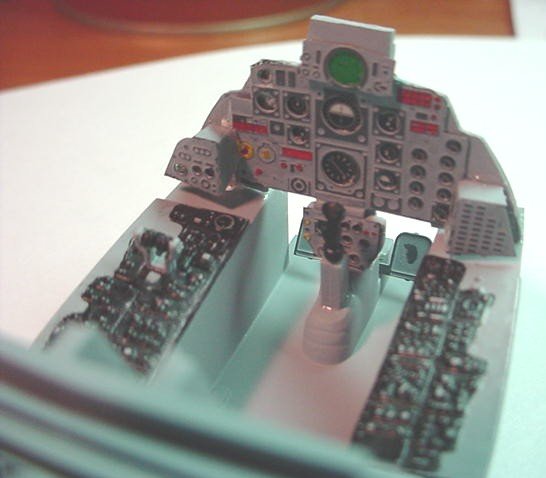
I don't know if this would
constitute scratchbuilding or not, but the only thing I used from the kit for
the cockpit was the tub, side consoles, and the control sticks. For the front
cockpit panel, the Eduard PE set was used. I painted the panel a dark gray
color, and then coated it with a clear gloss acryilic. After it dried, I then
painted it with a lighter gray enamel, and used some turpenoid on a fingertip
to remove some paint, leaving the raised areas the darker gray. I got this
idea from a great article here on ARC! I also found out that you can do this
on the plastic parts as well, not just the PE. I used the kit piece as a
template, and fashioned a new "panel" from some Evergreen plastic
sheet. I left the center portion white for the dials on the instruments, and
then sandwiched the clear instrument portion between the plastic and the PE.
Some of the plastic was built up in layers to give some depth to the panel.
Moving to the back seat, I really
went crazy! I wanted to make the area between the two cockpits look busy as it
does on the real thing. Since I was using the PE in the front, I decided to
completely redo the back too. For the top portion of the rear panel, I used the
same method as the front panel, but as a guide for the plastic I used a left
over rear panel piece from the Tamiya F-4. It has the "backs" of the
instruments on it and looks really nice. For the lower portion, I used some
leftover cockpit pieces from the same Tamiya kit. I'm glad the J kit has
cockpits parts for both the AF and Navy versions. I know its not accurate, but I
think it is a much more convincing looking cockpit. The seats came from CAM,
with the pull rings coming from the kit seats. A tip here: a fine point
"Sharpie" pen works great to paint the black stripes on the pull
rings. Inside the cockpits, I used some scrap pieces of resin pour blocks sanded
down to look like cockpit boxes and so forth, just to give the cockpit a
"busy look". For the cabling coming from the back panel, I used some
very small diameter plastic rod. This proved to be a challenge, as the rod
didn't want to stay connected to the backs of the instruments on the panel. So I
finally started making what I thought of as small "cannon plugs" on
the end of the rod with some CA. It built the ends of the rod up enough to give
me something to glue to the panel. For oxygen hoses, I used some pieces of
guitar string bent to various positions. Around the front panel coaming I used
some Tam. pieces (again!) just to add some detail. The HUD was also a leftover,
and the kit glass was trimmed to fit.
|
Click on
images below to see larger images
|
 |
 |
I put the gun
assembly and the cockpit assembly into the fuselage halves and here is where the
first problems started occurring with the kit. Since this kit has been around for
a while, the molds are beginning to get old I guess, because there was alot of
warpage in the pieces. Also, when I cut out the gun access door, I took with it
the locater pin for the bottom of the fuselage. This made the area hard to line
up. I also had to make a wall for the inside of the gun bay area. This was made
with a piece of plastic sheet, but was hard to get to join at both sides of the
fuselage so I finally just built it up so it would cover the bottom half. The
bottom fuselage piece was also badly warped, and it was hard to get the steps in
the seams to sand out. The top seam on the nose was also pretty bad. After I
sanded them down, there wasn't much detail or panel lines left. So I rescribed the
entire nose, a first for me. Before all was said and done, the entire fuselage
would be rescribed. After the nose section was done, it was set aside and I
moved on to the fuselage.
More fit problems
were encountered here. There was a pronounced step between the fuselage halves
on the top. After sanding and priming numerous times, it was rescribed also. Fortunately, I had just purchased a scribing template, and was able to get the
circles back that run along the top. I had already decided that I was going to
use the FOD covers that come with the PE set, so I didn't bother with all of the
engine face parts that go inside, just the large piece that goes inside the
intakes. The back section near the exhausts also had a large step that I was
never able to really clean up to my satisfaction. I then started on the intake
trunks. Anyone who has built an F-4 knows this is probably the worst part of the
build. I had a really hard time getting a smooth join out of the parts. I think
the fuselage parts might have had a slight twist because the parts were crooked
on the top on one side and the bottom on the other. After I installed the vari-ramps,
I noticed that the backs were hollow, so I cut some pieces of plastic sheet and
shoved them down the top and up from the bottom to fill it in. I sanded off the
inlets on the top and bottom of the kit trunks and replaced them with the PE
parts. Next...the wings.
These went together
fairly straight forward. I cut out the ailerons, and then built up the area on
the wing with some very thin plastic sheet. I thought about cutting the flaps
too, but chickened out! I think the kit instructions would have you put the
outer wings on at too drastic of an angle, so I put mine on a little lower. I
had to insert a plastic shim and sand it down to fill in the gap on the top of
the wings. The wings were then glued to the fuselage and it was off to the paint
shop.
After masking the
cockpit, the whole kit was primed and sanded, and then rescribed a little to fix
any lines that were lost. I then sprayed the tail area aluminum, and then dry
brushed some other colors like titanium gold, black, gunmetal, rust, and blue to
give it a "burnt" look. I also used heavy wash on this area and on the
metal areas of the tail surfaces. After this was clearcoated, I masked it off
and got ready to do the wraparound SEA paint scheme.
Then disaster
struck...
As I was getting
ready to start painting, I sat a glass of orange juice on the shelf that my air
compressor resides on. I mixed my paints and fired up the compressor. As I was
painting away, I heard a CRASH, BANG, SPLOOSH, BANG and thought "what the
^)(^*^)^&) was that!?!" as the wave of OJ hit me and everything on the
table. Yes, the glass was full. In case you're wondering, OJ will strip acrylic
paint really well! Some small pieces were broken and had to be repaired or
replaced. After cleaning up the mess (some of my sanding sticks are still stuck
together) I started over. I painted the model with MM Acryl straight from the
bottle. I used dark tan, and medium green. For the darker green, instead of dark
green I used Marine Corps Green, as it seemed to contrast better with the medium
green. My airbrush is one of those Testors double action jobs you can get in the
"gift pack" at Wal-Mart. It seems to do the job well. After I got the
camo done, I sprayed the gloss coat on for the decals. At first I used MM Acryl
clear. I've never had any problem with this stuff, but it didn't want to go on
very smooth this time. So I bought a can of the Tamiya Clear Gloss and sprayed
it on. This gloss coat seems to cover pretty well, and dries nice and smooth
fairly quickly.
|
Click on
images below to see larger images
|
 |
 |
DECALS
Since this was a
special plane, I needed some specific decals. Mike Grant came to the rescue! I
talked to my friend about the markings that his jet carried, and he supplied me
with the pilot and WSO names and the CC and ACC names. He also searched the net
and found me a picture of the squadron and wing crests, and told me where they
went on the plane. I sent the info to Mr. Grant, and he printed me some decals.
These are far and away the best decals made IMHO. They are EXTREMELY thin, and
went on without any silvering whatsoever. Mr. Grant provided me the names in two
different styles ( a nice touch ) and even printed a few extra tailcodes and
wing badges incase I made a mistake, which was good, because I needed them! The
rest of the markings, stenciling and such, came from the Aeromaster stencil
sheet and the kit sheet. The AM decals silvered some after I shot the dullcoat
on them, so I shot another coat of gloss on the whole thing and then another
coat of dull. That seemed to fix the problem. Before the dull coat, I weathered
the panel lines using the "sludge technique" and drybrushed some
silver on the leading edges of the wings, tail and intakes to simulate wear. I
wanted to keep the weathering to a minimum, as I didn't want my friend to think
that I thought he kept a dirty airplane! 
|
Click on
images below to see larger images
|
 |
 |
Then came disaster #2, which was
actually a blessing in disguise.
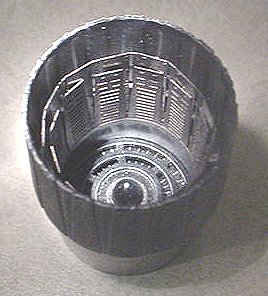
For the exhausts, I usually just
assemble the PE parts as two circles, paint them, put them on the pipes that
go in the fuselage, and then stick them in there. That to me always looks
better than the kit parts do. I use the tubes turned around backwards to keep
the PE round as I glue it together. That way it doesn't get smashed flat. But
as I was putting the last of the CA on the etch parts, I realized that I had
goofed in a big way. The PE was now firmly attached to the plastic. Pulling it
off resulted in a badly mangled piece of etch. In the trash it went. I would
just suck it up and use the kit exhausts. But as I was painting the plastic
parts I kept looking at the one PE assembly that had not gotten mangled,
thinking that there had to be a way to use it. After the outer kit exhaust
pieces were painted. I took the good PE pieces apart, reversed them, so the
detail was on the inside of the circle. I then put them INSIDE the kit part.
It looked really great, so I took the ruined piece out of the trash, cleaned
the CA off of it, and used it for the other side. Voila! Quite possibly the
most realistic exhausts I've ever done!
|
Click on
images below to see larger images
|
 |
 |
| LOADOUT
Moody AFB Phantoms were
known for dropping LGBs and as Maverick shooters as their specialties. My
friend was a valuable resource as to information on what the planes usually
carried. He informed me that their jets usually carried the Pave Spike
designator pod in the forward left Sparrow bay and the ECM pod in the
forward RIGHT missile bay. Since the E model has a large bulge on the nose
door, the ECM pod was mounted farther back in the bay. I worried about
this for a while, thinking it would look strange, but I have found two
pictures of this, so I guess it's right. |
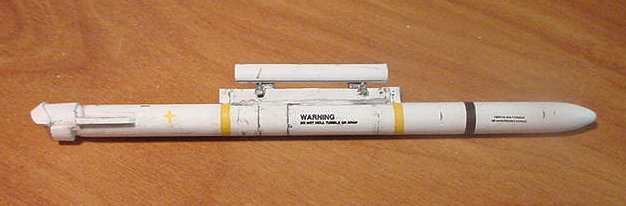
| The problem with
the Pave Spike pod was that one doesn't exist in 1/32 scale. So I made
one! The body of the pod came from two Sparrow missile halves from the kit.
I used the halves that don't have the fins on them. To make sure the size
was right, I used a very scientific method. I got a 1/48 Sparrow missile
and got out my 1/48 Spike pod from the Hase. weapons kit. Using the TLAR
method (That Looks
About Right) I decided it would work. |
Click on
image below to see larger image
|

|
|
| I left the missile length as it was.
For the seeker head, I held a piece of clear sprue over a candle until it
started to form a ball on the end. This took a few tries before I got one
that I liked. I then used some plastic sheet and tube to build up the area
around the seeker. For the mount on the pod itself, I used some square
plastic tube and a few other scraps. For the part that mounts in the
missile bay, I used a piece of U shaped plastic and a piece of T shaped
plastic, and some spare sway braces. For decals I used some scrap stripes
and stencils. |
The Maverick missiles and launch
rails came from the Trumpeter A-10 kit that I'm waiting to get the nerve up to
build. The finishing touches were added at this point: antennae, pylons,
landing gear, FOD covers and the weapons and drop tanks. The Tam. kit gave up
one more part, the boarding ladder. All those leftover Tamiya parts came in
handy on this project. For the formation "slime lights" I tried
something different. I cut pieces of reflective yellow tape so they would fit
on the back side of the PE frames. This was CA'd to the frames. Instead of
using glue to fix them to the jet, I just used the tape adhesive. This way, if
one wasn't in the right position, I could remove and reposition it. After they
were on there for about half an hour or so, they wouldn't come off, so I know
they are secure!
For the canopies, I brushed Future
on them, another first for me. I cant believe I have waited this long to get
on the Future band wagon, but I'll be using this from now on. The canopies
came out crystal clear, and any scratches were gone. I used the PE details and
a part from the Tamiya F-4 kit for the back seat rearview mirror attachment.
The PE part that goes here was put on the front of the center section instead
of the back so it would look like there was some framing there.
CONCLUSION
I started on this kit in April of
last year. I finished it on Feb 25th! I stopped work on it while I was waiting
for the custom markings, but really started hitting it hard toward the end of
the year. It has been by far the most enjoyable model I've built to date, but
I say that everytime I finish one! Even with the fit problems it was a joy to
build and finally finish. I have learned many new techniques from this kit.
Special thanks go out to Mike Grant for the custom markings and my friend
Wayne Williams for helping me get it right. This project was a little
stressful because someone who has actually seen and touched THIS jet was going
to see the final product. If there was something wrong with it, he would know
it. When he told me "that looks exactly like my jet!" I was very
proud...and relieved! The G model that I built years ago is going to go into
"deep maintenance" and come out with a new paint job...marked as
69-0291 after it was converted! I think those will look nice sitting next to
each other on the shelf.
Happy Modeling!
Mike
|
|