|
Using
Leading
Edge Models decal sheet #48-24
Hasegawa
Kit # P24
Verlinden Kit# 689
HISTORY
The
pride and joy of Canada’s Air Command fighter pilots, the CF-18 provides
air-to-air interception and air-to ground support to the army. The CF-18 was
acquired in 1982 to replace the CF-104, CF-101 and CF-5. With the addition of
precision-guided munitions capability, the CF-18 will serve into the next
century. The first CF-18 was rolled out on 28 July 1982 and has proven to be
ideal for the Canadian Forces. The Aircraft is a dream to fly, according to its
pilots, and it has proven up to its task in performing its demanding dual role
as an interceptor and ground attack fighter. 138 CF-18s were bought for the Air
Force with the first one arriving at CFB Cold Lake in the fall of 1982. With its
combination of advanced flight controls and powerful and reliable engines, the
Hornet is equally comfortable at high or low altitudes. The Hornet is a classic
"turn and burn" weapons delivery platform. McDonnell Douglas designed
the Aircraft as a multi-role fighter, which means it excels at attacking both
ground and air threats. A CF-18 Hornet gets all the take-off power it needs from
two General Electric F404-GE-400 engines, each producing 7,299 kg of thrust. The
CF-18 Hornet can carry Sidewinder and Sparrow missiles as an air defence fighter
or, 17,000 pounds of ordnance as a strike Aircraft.
The
F/A-18 is in service with the U.S. Navy. U.S Marine Corp and the air forces of
Canada, Australia, Spain, Kuwait, Finland, Switzerland, and Malaysia. As of May
1999 Hornet pilots have accumulated more than 3.7 million flight hours and, in
the process, are establishing new records daily in safety, reliability,
maintainability and mission performance.
Canada
was the first international customer for the F/A-18, and its fleet of 138
Hornets is the largest outside the United States. Deliveries to Canada were
completed in 1988. Canadian CF-18s operate out of Canadian Forces Base Cold
Lake, Alberta; and Canadian Forces Base Bagotville. The Canadian Forces are
currently planning an aircraft modernization program, which would significantly
upgrade the avionics of their CF-18s.
THE
KIT
I must confess that I am not a big modern jet
modeller; my passion is 48th scale Luftwaffe material. But, being a
good old Canadian boy I knew that eventually I would have to build a CF18.
Being a WWII modeller, most kits I open have 40 ish parts and slam
together pretty fast allowing me a lot of time to weather and tinker.
Imagine my surprise when I opened this kit revelling 220 beautiful pieces
of moulded plastic coupled with a Photo etch sheet and a book for instructions,
YIKES !! Well it took me almost 10 years of quietly placing this kit back on the
shelf in fear to get busy and build this bird.
Add on the Verlinden update and the project quickly reaches the 300 parts
threshold. Well
all we really require is a few cases of brew and some time.
Away we go……
Verlinden
Update
| The
update is another very nice offering comprising of resin and photo etch.
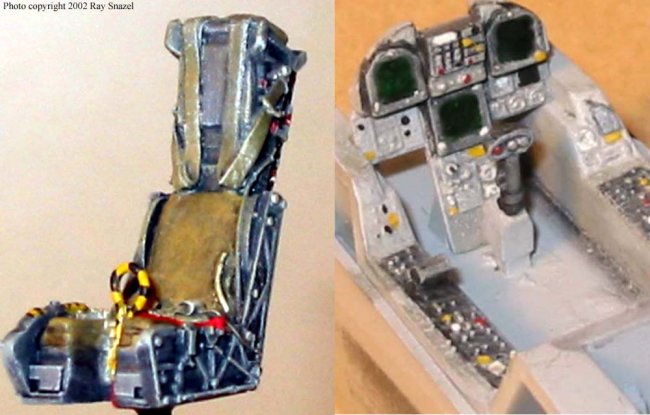
It provides full canopy rails and cockpit side walls, a very nice ejection
seat, sparrow missles, ladder, wing fold kits, and a few more odds and
ends. I choose to use the folding wings on another project as well as the
nose radar array. |
| Click
on image below to see larger image |
 |
|
CONSTRUCTION
Cockpit
| The cockpit, which happens
to be my favourite part of the whole kit, went together with the update
set fairly painlessly. First
up was the ejection seat, the resin block was carved off and the whole
seat sprayed a very darkened Gull Grey.
The actual seats are black but personally I have found black almost
impossible to highlight realistically and the washes never show up.
After a base coat of dark gull grey I blasted future to seal the
base and once dry applied a black oil wash thinned in turpentine.
Once that was dry the whole seat was dry brushed with different
shades of grey until the desired effect was reached.
The seat cushion and belts were painted 2 different colors of khaki
followed by some red for warning placards and some silver and yellow were
appropriate. Once all the dry brushing of the cushions and parachute pack
was completed the whole seat was blasted with Poly S flat and set aside.
|
| Click
on image below to see larger image |
 |
 |
|
| Next were the
guts of the cockpit and canopy rails from verlinden.
The whole cockpit tub was painted light ghost
grey and then the CRT’s painted black along with the removable panels on
the side consoles. Another
sealing with Future, followed by a black wash set the tub and front panel
up for detailing. The side
consoles were dry brushed a medium grey while anything light grey was dry
brushed with an extremely light grey just a tad off of white.
The CRT’s were painted with clear green.
The tub was then blasted with flat and as a final touch, the green
CRT screen were touched with a spot of future to give them a glass look. |
| Click
on image below to see larger image |
 |
|
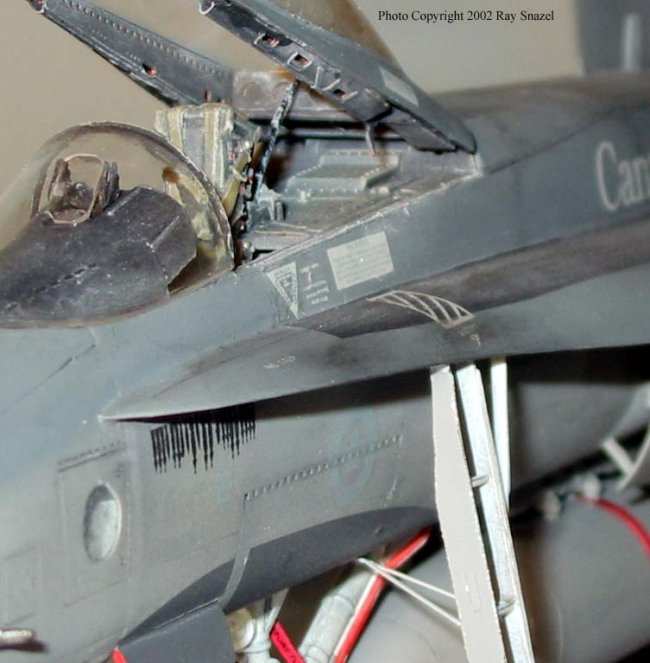
The
cockpit rails and area behind the pilots seat was painted the same dark grey I
used for the seat, again according to references this area is black but same
reasoning was applied to this area. I personally believe to “duplicate not
replicate”. This picture actually
shows the side panel of the cockpit tub as well as the rails.
The verlinden kit supplies a large piece of etch that goes from the
bottom of the glaresheild all the way back to the canopy hinge. Well, if you can
bend this to look right I salute you. I
chose a few select cuts on the etch and it settled into place nicely.
Same format here with the washed and dry brushing to get the desired
“depth” look to the rails and rear cockpit.
Fuselage
and Wings
|
Once
the cockpit was installed, the fuselage halves were glued together. The
underside of the Leading Edge Extensions (LEX), in particular I had
trouble mating up. Eventually
they came together with a bit of putty and all worked out nicely. The nose
cone I had to modify for the Canadian forces version with the search light
on the left side forward of the LEX. Attaching the nose to
the fuselage halves was probably the most difficult part of the
constructions process. Take some time with this point and it will save you
a lot of grief later.
The wings allow for flap
and slats in two positions, most of the static F18’s I had pictures of
had the slats out and the flaps in the extended position. The slats are two pieces and drop into place easily; the
flaps are 6 main parts with rails and a extension on the top of the wing,
no problems at all here. Now
we were cooking, I chose to jump ahead on the instructions
and place the horizontal and vertical stabilizers so get a feel for the
overall look of the kit. I
love the lines on this plane, really shows a lot of the aerodynamics used
to get the performance required of this project.
The engines were sprayed and built separately and placed to the
side for attachment at a later date. |
| Click
on image below to see larger image |
 |
|
|
Click on image to
right to see larger image |
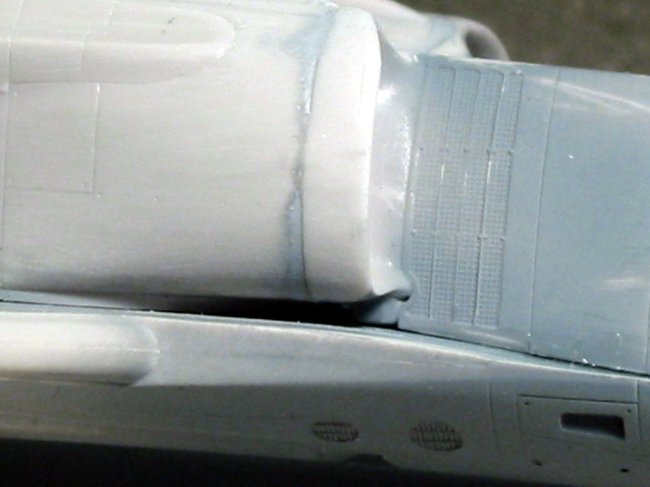
Step 5 is the attachment of the engine
intakes and fuselage sides. There is a distinct ridge on the seam between the intakes and
the fuselage sides, this took a lot of fidgeting to get the fuselage
looking right while trying to reduce the sanding needed later. To make a long story longer, be careful, I had to do a lot of
sanding to get the fit just right. Putty
to the rescue. |
|
Landing
Gear
|
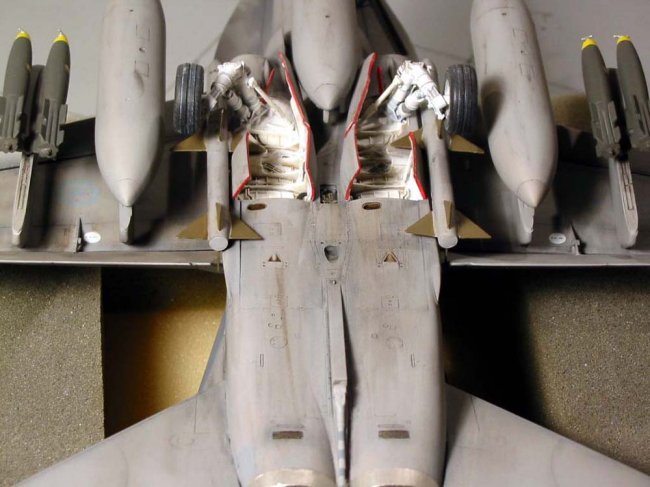
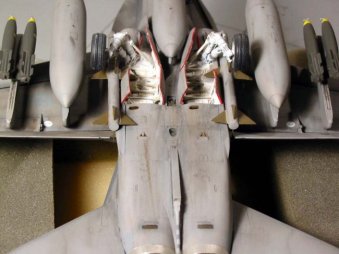
The
Landing gear is a thing of beauty, its just to bad that you have to paint
it white, makes it kind of hard to weather but more on that later. The
main gear and the nose gear are metal and clean up extremely easily
leaving a highly detailed addition to your kit. The
gear doors have a lot of ejector
pin marks but they clean up very easily.
All I added to the wheel wells was some home made “Remove Before
Flight” ribbons and drybrushed in some dirt for the final touch.
The gear was painted white first then pre shaded dark grey followed
by another coat of white to get the shadow effects. |
| Click
on image below to see larger image |
 |
|
PAINT
& DECALS
The
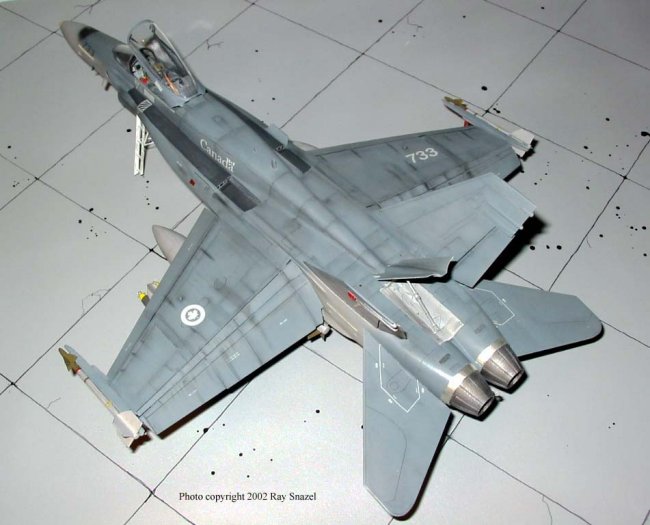
decals come from Leading edge out of Calgary. This is a massive sheet giving you
2 full aircraft stencil sheets and enough numbers to do any aircraft in CAF’s
inventory. There are decals for
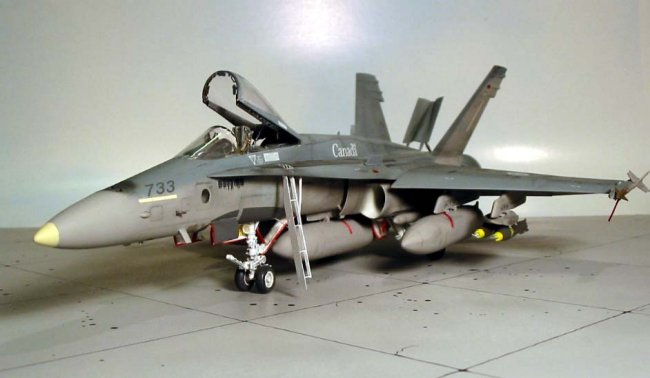
many different squadrons and options for Balkans operations. I chose Aircraft
733 which flew in the Balkans campaign. Being
fully impressed with the sheet of decals I pressed on with the painting.
My only disappointment with the decals would come later, This is my first
set of Leading Edge decals and I found them very thick and hard to settle down.
It took a lot of work with Micro set and Micro sol to get the detail under the
decal to come through. They
also tended to silver very easily. Again a great set of decals but not thin like
the Aeromaster decals I am accustomed to.
|
| Painting
started with a primer light grey and then continued with the pre-shade.
Once this was
completed I proceeded to
apply the camouflage colors. The
underside was painted Light
Grey FS 36375 and the top painted Medium Grey FS 35237.
Once dry I proceeded to further shade the topside to simulate
weather due to the sun. This
was accomplished by spraying increasingly lighter shades of the original
color.
|
| Click
on image below to see larger image |
 |
|
Once dry the whole model was painted with a few coats of future for decal
prep. The decals were applied and
another coat of future sealed them for weathering.
I really experimented with the weather at this stage, having seen many
F18s up close they are very simply FILTHY!
First order of business was a oil / turpentine wash of black in all the
panel lines. Before this dried I
took a small sponge and wiped with the direction of airflow to get some streaks.
These all originated from a hinge point of something that could generate this
streaking. After this was dry (2
days) I applied a Raw umber wash in places to give a bit more definition in the
places that the black missed, most of the umber went on the belly and
selectively on the top surfaces. At
this point the first coat of Poly S flat was applied.
With the flat coat I was now able to start with the pastels for the
cannon areas and some streaking on the vertical stab’s and some weathering in
the speed brake area.
|
Click on images below to
see larger images |
 |
|
FINAL
ASSEMBLY
3
drop tanks, 2 sparrows, 2 sidewinders and 4 snakeye’s from my research was a
realistic weapons load for a Balkans mission so there were placed in their
respective positions. The
snakeye’s came from a Hawegawa weapons kit.
Another
flat coat was applied after some more red flags were positioned and it was time
for the canopy and ladder. The
ladder provided from the kit is plastic and photo etch. I choose to use this
over the verlinden ladder purely because had trouble getting the verlinden
ladder to look right.
REFERENCES
-
Leading
Edge decal sheet #48-24
-
F/A
18A/C & CF18C Hornet. Verlinden Publications Lock On #15, book # 692
-
Vic
Holland, CAF CF118 pilot /
Instructor – Retired
-
Jason
Kendal, CAF CF118 pilot - Retired
Ray
|
|