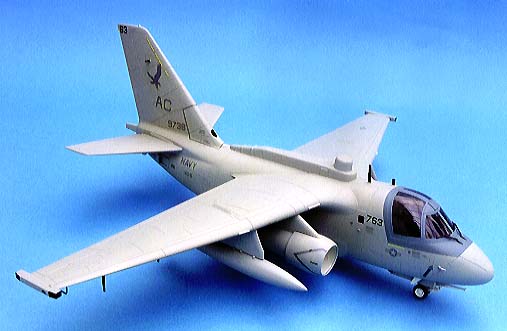
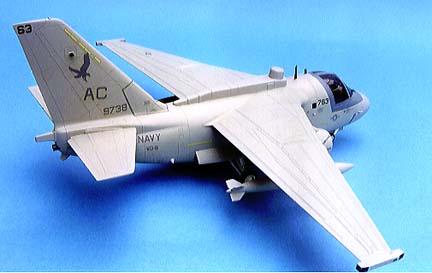
| The Shadow is a
derivative of the S-3A Viking sub hunter and is tasked with long range
airborne early warning for aircraft carriers, it has a range of seven
hours, five of these can be loitering on station. Two squadrons operate
them VQ-5 and VQ-6 and it is one of the latter that is depicted in this
kit serving on the "IKE" CVN-69 whilst on her Gulf cruise in
1995. |
| ESCI first issued the original
Viking model many years ago and at the time was one of the finest kits in
the world with excellent engraved panel lines, parts that fitted like a
dream and a cockpit that could be fitted after the main assembly was
completed. Being grey over white the standard navy colours, one could fix
the undercarriage before spraying the bays and underside along with the control
surfaces, minimum masking was required and the grey could be airbrushed
freehand with ease, there were a lot of colourful schemes provided on
specialist decal sheets and I built quite a few but I still do not see
many models at shows or club meetings which is a pity I feel. The new kit
is still as good as ever but now contains new frames with all the humps
and bumps that distinguish this machine but the markings are now low viz
on an overall grey scheme, not quite so bright but appealing none the
less. The fit of some of the new parts are not up to the original
standards but the problems are easily overcome. |
|
|
Construction
notes you might find helpful
The instrument panels are depicted with decals and I like to seal these in
with Johnson's Klear especially if the model is to be washed before
painting I once watched them float off and learned my lesson the hard way.
Step 4 You may need to
drill out the mounting holes in the bay walls for the tail hook (part 40)
which the instructions tell you to paint black and yellow but dark grey
stripes are provided on the decal sheet suggesting the colour should be
light grey.
Step 5 The nose gear bay
when fitted barely touches the fuselage at it's front end so when I added
some lead shot weight in the nose with epoxy resin I ran a little
bead around it's edges for strength and the ports (parts 106) were left
out till the painting was done but before the cockpit was fitted.
Steps 6/7 If the doors are to be
left open all is well but to close them you will need a couple of strips
of plasticard cemented to the edges of the bays to locate the parts and
fill the gaps, much the same applies to the electronic bays doors, I
fitted the long narrow doors and added a strip of 40thou card, overlapping
to make a location for the bulged doors then fitted a strip of 20thou card
to the top lip of the bay before adding the doors this was trimmed after
hardening, a little filler was needed at this point to blend the doors
into the fuselage, I decided to add the new belly panel (part 94) at this
stage rather than step 14 then all the aerial blades were removed from top
and bottom of the fuselage and wet and dry paper was used to clean
up the filler before the wings etc. were added |
|
|
Step
8 make up the wings but only add the blade antenna just prior
to painting and the towel rack antenna ( part 208) are best left until the
very last step.
Step 9 take care assembling the
ECM pods, make sure the navigation lights match up and are facing forward
then cut the nav. light off the end of the wing so the pod fits tight.
Step 11 build up the engines but
don't add the bypass fans (part 2) as these
can be built into the cowl sections in step 12 making sure that the
location slot is exactly at the 9 o'clock position level with the tiny pin
on the cowl, to ensure your engine is the right way up, this all makes it
easier to clean up the joins and simplify the painting. |
|
At this stage I
departed from the instruction sequence, part 203 the APU intake needed a
little gentle bending into shape to match the side wall and part 204
the ALD-9 antenna needed a little sanding to match the tail end even then
after fitting a drop of pva glue was needed to "bridge that
gap". Wings and tailplanes were next to be added, any joins were
cleaned up and all the blade antenna were positioned including those on
the fin there is some discrepancy regarding the RDF antenna (parts
207) location, the drawings and box top show a high spot while the built
up model photo shows a lower spot I wonder who made the mistake. |
| I am often asked which order I
paint a model in so here is a quick run through my way, firstly I spray
items like wheel bays which can be masked with the kit doors held in
position with a lump of blue-tak or intakes with rolled paper towel next
the canopy is masked using clear sellotape this and the cockpit area are
then sprayed with the dark grey which can now also be masked using
Tamiya tape, the overall colour can then be sprayed and when dry given a
couple of misted coats of "Klear" ready for decalling. |
|
| A little tip I
tried recently was to feel the surfaces and if they feel a little rough
give them a very light rub over with worn 1200 grade wet or dry paper and,
the silky finish is truly amazing and just right for the decals. I may
have mentioned before that If I see the slightest trace of silvering with
the decal I add a tiny brush full of "Klear" under the offending
item just lifting it slightly to apply then after a few moments as it
dries roll a finger over the decal to remove any excess which can be wiped
away now spray another couple of misted coats of "Klear"
and all is sealed in. |
|
|
Now is the time to do any
weathering that might be appropriate then tone down the finish with Revell
No. 2 matt varnish to what ever degree suits you again only mist it on and
it should be dry in no time at all. Any hand painting can now be done i.e.
engine fans and navigation lights etc. all my lights and radar scopes are
given a coat of silver then add the particular colour from the Tamiya
clear range, |
| All the remaining
parts, wheels, engines, pylons and pods should be added now , I use
superglue and activator, one on the part the other on the location
resulting in speedy hardening leaving just a little time to adjust if
needed, finally fit the small windows into the fuselage then in goes the
cockpit and the canopy can be secured with Slaters Mek-Pak, the strip
lights need brush over with gloss varnish to bring them to life then all
you need is those two fragile antenna you should now be looking at a first
class model . I like the aeroplane and the kit it gave me
quite a few hours of enjoyable modelling I Hope it does for you whether
you are a US Navy fan or not, it's good to find a kit that gives no
problems once in a while.
Ted |
|
|
To see more of Ted
Taylor's models....go to
Ted
Taylor's Modelworks
|
|